Skip to content
GASB

We connect Germany’s synthetic biology community.

GASB is a non-profit association run by early-career scientists. We organise conferences, speak up in politics, map where synthetic biology happens and explain the field to anyone who is curious.

What we do

  • Conferences and meetings

    Since 2017 our annual conference has brought the German synbio community together. We co-organise the German Conference on Synthetic Biology and run the SynBioReactor for founders and investors.

    See our formats
  • A voice in politics

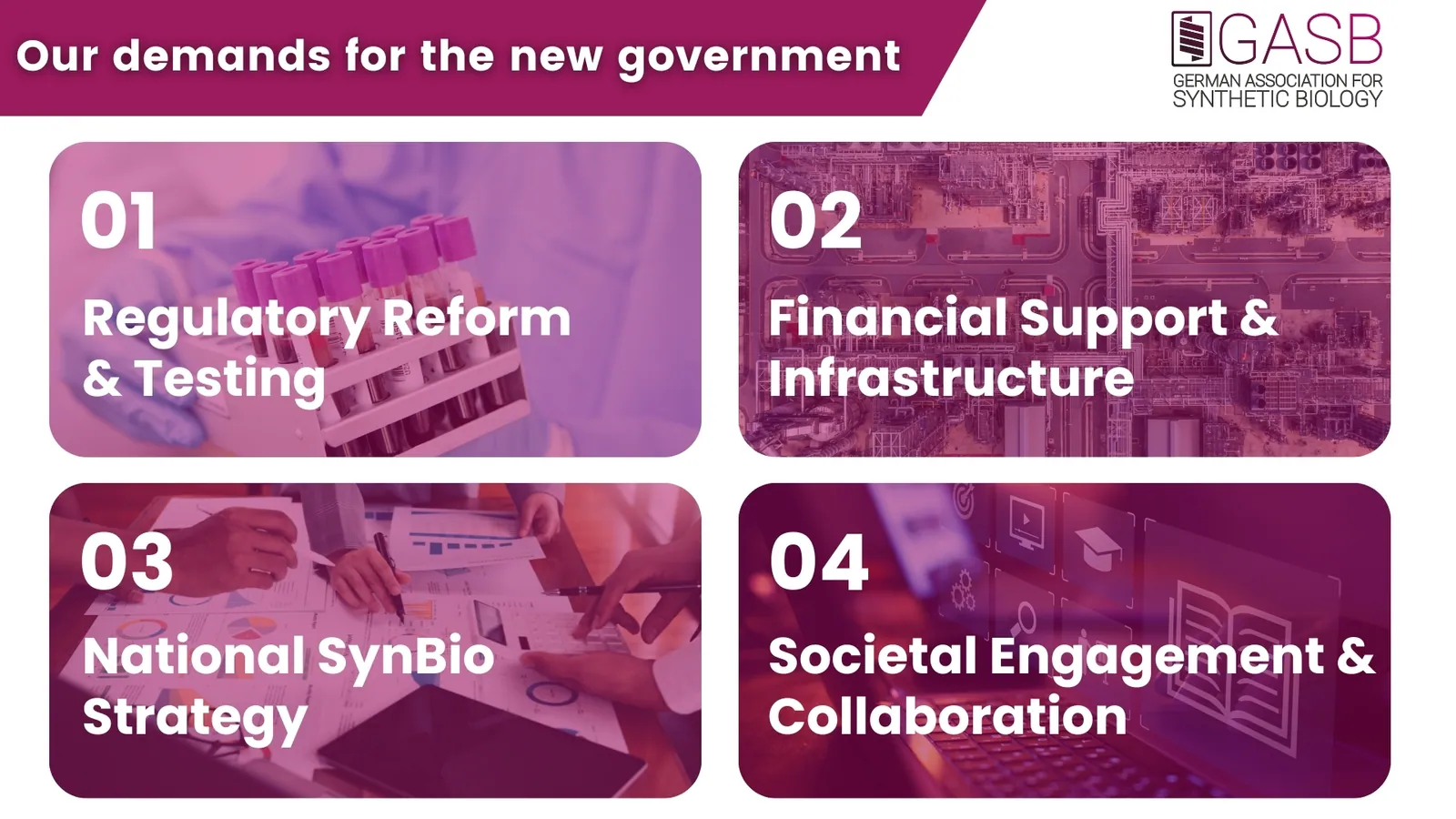
    We ask parties where they stand, survey our community and bring its demands to Berlin and Brussels: from gene-editing rules to research funding.

    Our political work
  • The SynBio Atlas

    Where can you study synthetic biology, and which labs work on it? The Atlas maps master’s programmes and research groups across Germany.

    Open the Atlas
  • Explaining the field

    Synthetic biology raises big questions. Our guide explains how it works, what it is used for and how it is regulated in Germany, in plain language.

    Read the guide
774222222222MarburgDarmstadtPotsdamJenaMunich

Synthetic biology happens all over Germany

53 research groups and 5 master’s programmes in the Atlas so far. Missing your lab? Tell us and we’ll add it.

Marburg
7
Darmstadt
7
Potsdam
4
Aachen
2
Magdeburg
2
Jülich
2
LabsMaster’s programmes29 cities
Explore the Atlas

Synthetic biology, explained

Engineers design, build, test and learn. Synthetic biologists do the same with living cells. Our guide walks you through the field in 10 short chapters.

  1. 01What is synthetic biology?
  2. 02The code of life
  3. 03Engineering meets biology
  4. 04The toolbox
  5. 05Cells, circuits and synthetic cells
  6. 06What it makes
  7. 07Is it safe?
  8. 08Who decides?
  9. 09Values, myths and public views
  10. 10Past, future and you
Start the guide
Design → Build → Test → Learn1Design2Build3Test4LearnThe engineeringcycle
1. Design: Plan the genetic parts on a computer. 2. Build: Synthesise and assemble the DNA. 3. Test: Measure what the cells actually do. 4. Learn: Use the data to improve the design.

Latest news

All news

No upcoming events are listed yet. New dates are announced here and on LinkedIn.

Join the community

Membership starts at €12 a year. You get reduced fees and priority places at our events, and a national network.

Annual fees
Students and apprentices12 €
Unemployed or on parental leave12 €
Pensioners18 €
PhD students36 €
All other members72 €

Projects and collaborations